A plain-English guide to picking a weather radio that actually keeps your family informed when the power and cell towers go down — features that matter, and what to skip.
When the power’s out and cell service is spotty, information is its own kind of comfort. Knowing whether a storm is passing or getting worse — whether it’s safe to go outside, or time to move to the basement — is the difference between anxious guessing and calm decisions. That’s the job of a weather radio: a simple, reliable line to official alerts that keeps working when your phone can’t.
There are a lot of models out there, and most of the differences don’t matter much. Here’s how to pick the right one for your family without overthinking it.
What a weather radio actually does
A dedicated weather radio receives broadcasts from NOAA Weather Radio — a nationwide network of government transmitters that runs 24/7 with forecasts and, crucially, emergency alerts for your area. Unlike a weather app, it doesn’t depend on cell service or the internet, so it keeps you informed exactly when those go down.
The best models also pull double duty as an emergency power source and a light, which is why one good weather radio often replaces two or three other gadgets.
The features that actually matter
Ignore the long spec lists. For a family, these are the four features worth caring about:
1. Power that doesn’t depend on the grid
This is the whole point, so look for multiple ways to power it:
- Hand crank — cranking for a minute gives you several minutes of radio. It never runs out.
- Solar panel — trickle-charges in daylight, hands-free.
- Rechargeable battery — holds a charge for everyday use.
- Regular batteries — a good backup to the backup.
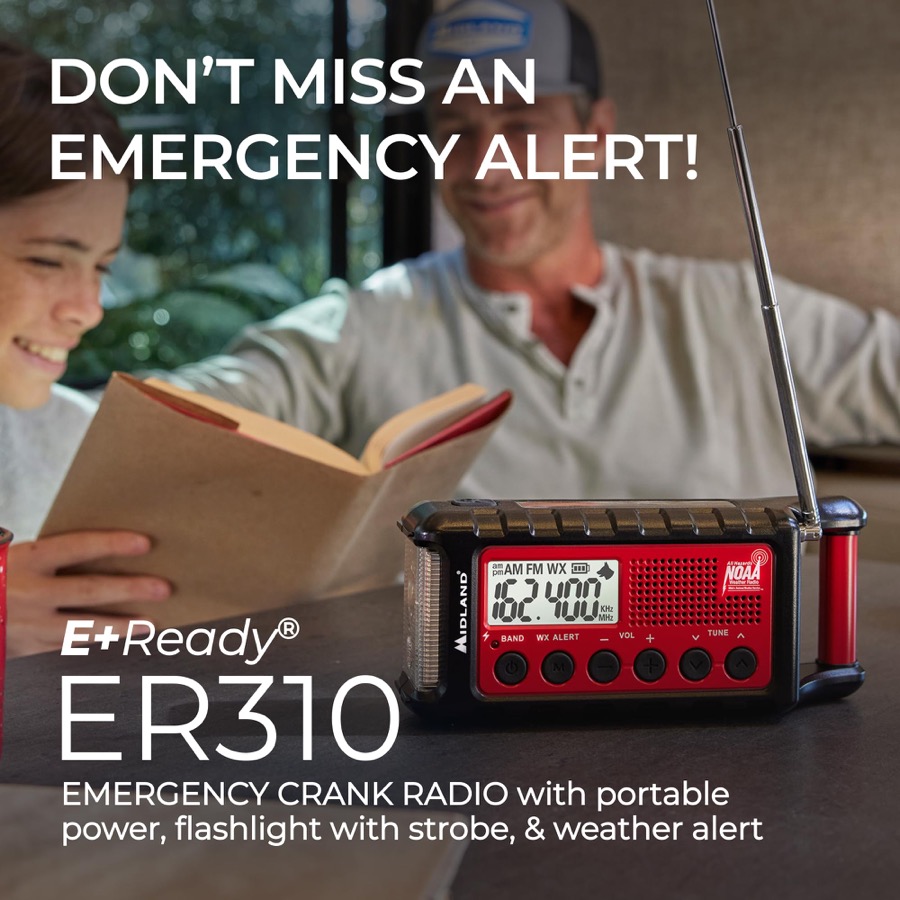
A radio with crank and solar and a battery, like the Midland ER310 or the Eton FRX3, will simply never leave you without a way to hear an alert. This is the category to prioritize.
2. NOAA alerts with “SAME” targeting
Look for public alert / SAME technology. This lets the radio stay silent until there’s an actual alert for your specific county — then it sounds automatically, even overnight. Without it, you’d have to sit and listen to routine broadcasts to catch anything. With it, the radio quietly watches your area for you and wakes you if it matters.
3. A USB port to charge your phone
Many crank radios can charge a phone from their built-in battery or crank. It’s not fast, but a few minutes of cranking for an emergency text is a genuine feature — it turns your weather radio into a backup for keeping a phone alive when everything else is dead.
4. A built-in flashlight
A small thing that’s surprisingly handy: most emergency radios include an LED flashlight, and some a wider area light or a red beacon. One less thing to grab in the dark.
What you can safely ignore
- Shortwave and endless bands. Fun for hobbyists, irrelevant for family safety. If you do want long-distance listening, a well-built receiver like the C. Crane Skywave is the enthusiast pick — but most families don’t need it.
- Bluetooth speakers and gimmicks. Nice-to-haves that add cost and drain batteries. The core job is alerts and power.
Where a weather radio fits in your family’s comms plan
A weather radio is for receiving official information. It pairs naturally with a couple of other simple tools that cover talking to each other:
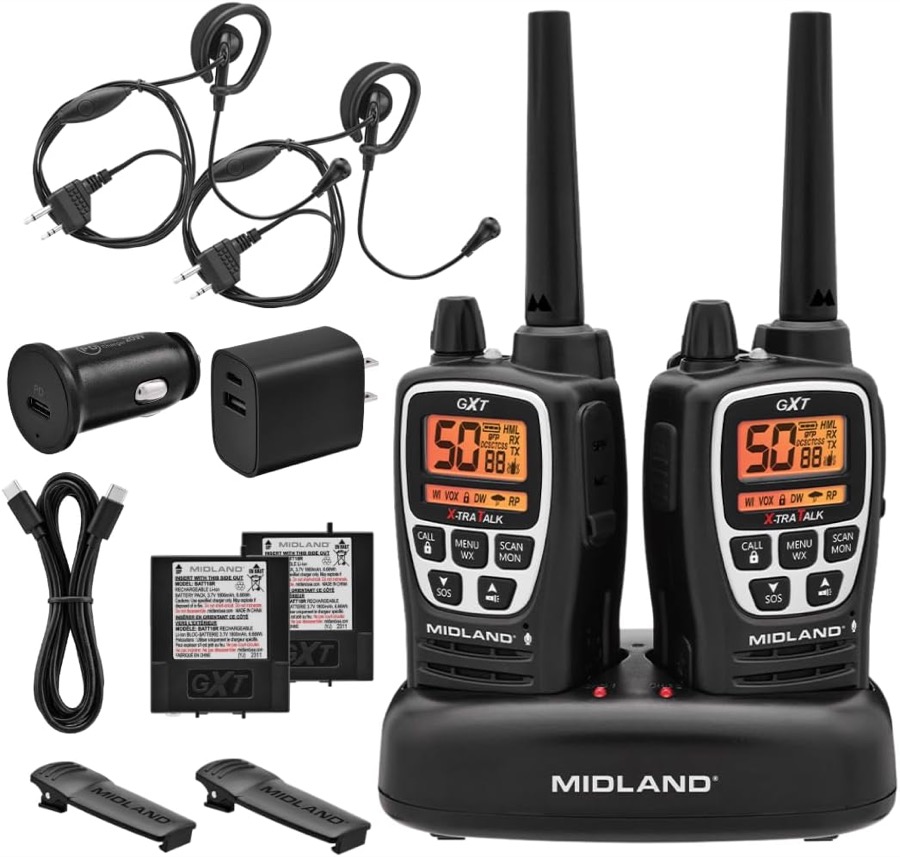
- Two-way radios let family members stay in touch across a neighborhood or campground when cell networks are jammed — helpful during an evacuation or a big storm. A set like the Midland GXT67 is easy for the whole family, kids included. See our two-way radios roundup.
- For families who venture truly off-grid — remote camping, wildfire country with no cell coverage — a satellite communicator can send a text or an SOS from anywhere. That’s a step beyond what most families need, but worth knowing exists.
Together, a weather radio (to hear alerts) and two-way radios (to reach each other) cover the whole communication picture for a fraction of the cost of fancier options.
Set it up before you need it
A weather radio does no good in the box. When yours arrives:
- Program your county so SAME alerts are specific to you (the manual walks you through it — it takes a few minutes).
- Charge it fully and learn the crank and flashlight so you’re not reading instructions by candlelight.
- Test the alert feature so you recognize the sound.
- Store it with your other outage gear — flashlights, power banks, batteries — so it’s all in one grab-and-go spot.
Then check it when you rotate your other supplies twice a year, and top off any rechargeable battery.
Your calm next step
For most families, a single crank-and-solar radio with NOAA SAME alerts and a USB port — like the Midland ER310 — covers everything that matters and costs about as much as a few takeout dinners. Browse our weather radios roundup to compare, then add a set of two-way radios if staying in touch across distance matters for your household.
It’s a small, one-time purchase that means the next time the power’s out and the sky looks uncertain, you’ll actually know what’s happening — and knowing is where calm comes from.
By Sunny Supply Co.